
The best center console boat is the one that matches exactly how you fish, where you run, and who comes along. What separates a great center console from a mediocre one comes down to five things: offshore performance in real conditions, fishability under pressure, comfort for the whole family, construction that holds up season after season, and resale value that protects your investment.
Contender Boats is a U.S.-built, hand-crafted center console manufacturer with two Florida factories in Homestead and Fort Pierce and more than four decades of continuous production. Every hull that leaves the floor is custom-built, so no two Contenders are ever exactly the same. The fleet spans 14 models from 24 to 44 feet, engineered for serious offshore sportfishing, tournament competition, and family boating.
This guide exists to help you identify the best center console boat for you: whether that’s bluewater canyon runs, nearshore reef fishing, tournament circuits, bay-and-flats sight casting, or a true crossover that handles all of the above. We’ll walk through hull design, model-by-model recommendations, how to choose the right power and options, and how to work with a dealer to build a boat that fits your life on the water.
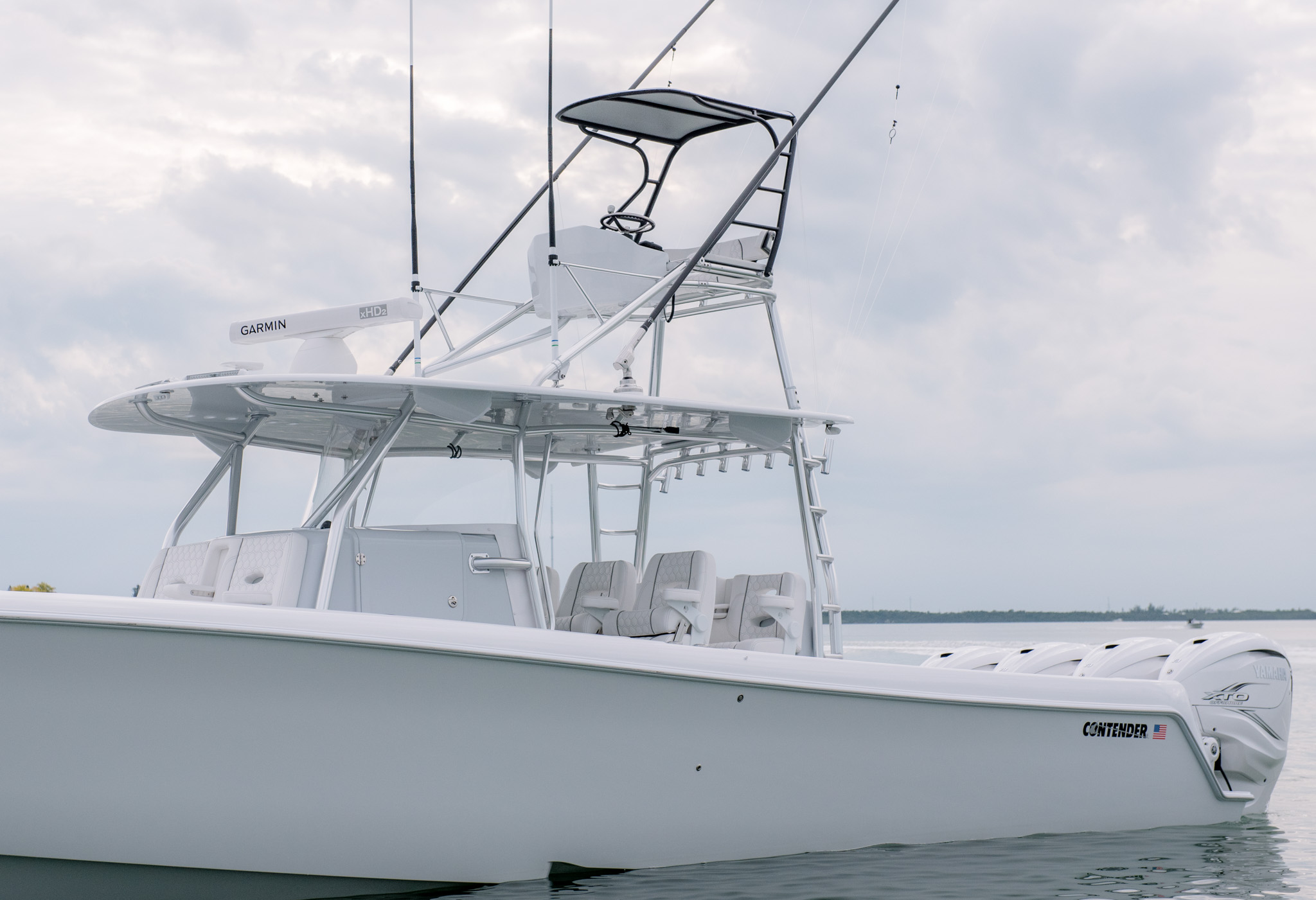
Before comparing models, it’s worth understanding why certain center console fishing boats outperform others year after year. The answer starts with hull design, construction quality, power integration, and the depth of customization available to each buyer.
Contender offers both deep-V and stepped-hull designs across its lineup. Deep-V hulls, with high deadrise angles, slice through rough water and deliver a smooth ride in head seas, beam seas, and following swells. The ST series runs on Contender’s patented stepped hull, with a dual-step design on the 35ST. The steps create lift and reduce drag, improving efficiency and top-end speed. The result is a faster, more efficient platform for long offshore runs.
Every Contender is hand-crafted at Contender’s two Florida factories. There’s no assembly line here: just American craftsmanship refined over 40-plus years of building boats for saltwater punishment. From stringer grids and transom layups to bilge access and dive platform integration, the construction is engineered for durability in the toughest offshore environments. Contender’s track record bears that out in long-term owner satisfaction and strong resale values.
On the power side, Contender rigs single, twin, triple, and quad outboard configurations, from a 350 HP max on the 24BAY up to 1,800 HP on the 44 models, matched to each hull’s displacement, intended use, and owner preferences.
What truly sets Contender apart when comparing the best center console boats on the market is the custom build process. Buyers specify everything from engines and control systems to livewells, seating layouts, electronics, gel coat colors, lighting, audio, and upholstery. With hundreds of configurable options across 17 categories, every boat is rigged to its owner’s exact specifications. That level of customization lets anglers optimize for specific fisheries, crew sizes, and family needs.
Picking the right center console starts with answering a few questions about where you fish, how hard you fish, who comes with you, and what you’re willing to invest.

Inshore bays, flats, and rivers demand shallow draft, maneuverability, and casting platforms. Nearshore reefs, wrecks, and passes require a comfortable ride through chop with enough range to reach productive structure. True offshore fishing (canyons, gulfstream edges, deep-water humps) calls for serious fuel capacity, high deadrise, and the confidence to run 40, 60, or 100-plus miles from the inlet.
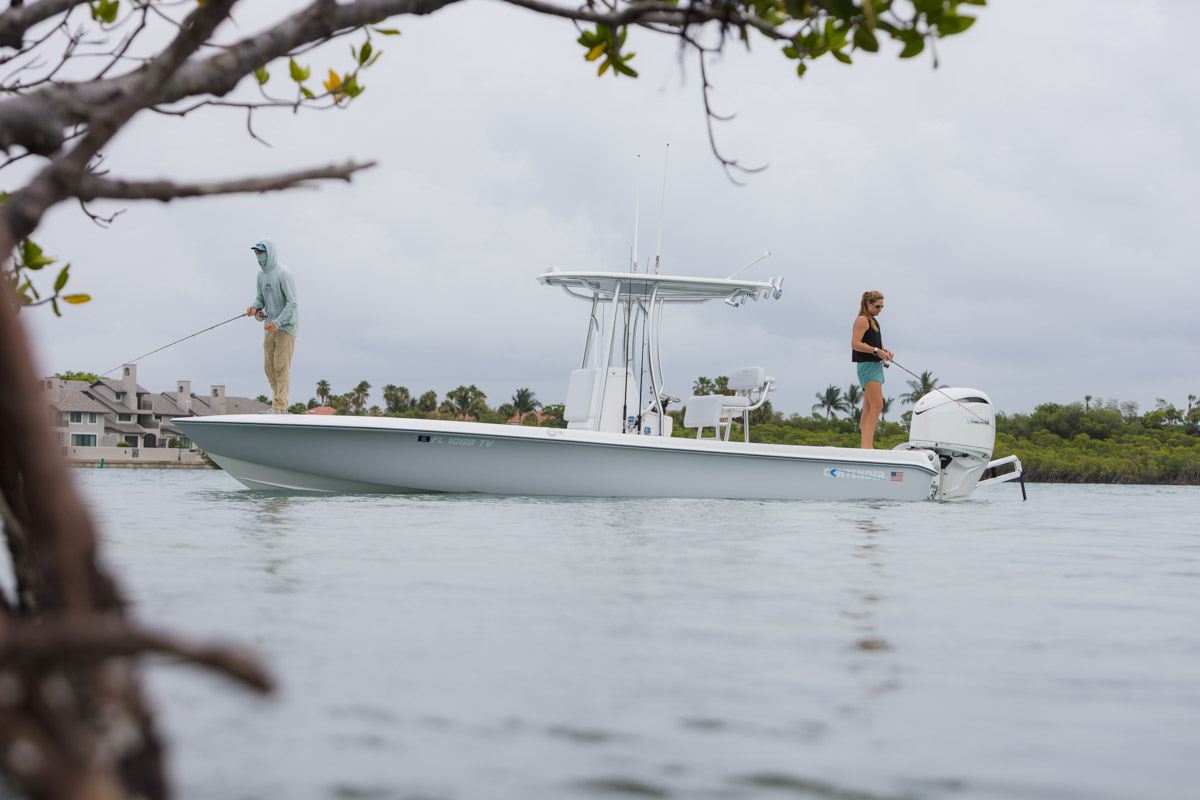
Contender’s Bay Series (24BAY, 26BAY, 29BAY) is purpose-built for shallow and mixed waters, with skinny-water hulls, oversized casting platforms, and the kind of open deck space that lets anglers move freely while battling fish. The 29BAY bridges the gap with optional twin engines and ~180 gallons of fuel for a roughly 500-mile range, enough to fish the flats during the week and venture offshore on the weekend.
If you routinely run 40-plus miles offshore, prioritize range, deadrise, and fuel capacity. The 35ST, 39ST, 44ST, and 44CB carry 400, 500, and 600 gallons (on the 44s) of fuel respectively, with 24.5° of deadrise on the 35ST and 39ST and 22.7° on the 44ST & 44CB.
There’s a pretty big difference between weekend fishing and year-round tournament competition. Casual anglers value a stable ride, enough room for friends, and reliable fishing features. Tournament teams demand speed, efficiency on long runs, massive livewell capacity, and helm layouts that support large-screen electronics for navigation and fish-finding.
Contender’s ST models, the 30ST, 32ST, 35ST, 39ST, and 44ST, use stepped-hull technology to maximize speed and fuel efficiency during the punishing runs that tournament schedules require. Every ST carries twin transom livewells: 40 gallons each on the 30ST, 32ST, 35ST and 39ST, and 55 gallons each on the 44ST. Add dedicated rod storage, insulated fish boxes, and helm consoles designed for serious electronics real estate. For 2026 and into 2027, Contender reworked the consoles on the 39ST, 35ST, and 32ST to be wider and longer, providing more mounting space and improved forward visibility.


Hardcore anglers want center console boats that offer 360° of open deck space, large cockpit layouts, tackle and ice capacity, and self-bailing cockpits that allow for easy cleanup after fishing.
But if your boat purchase also needs to serve as a family boat, comfort features matter: bow seating for lounging, shade from hardtops, a head compartment for convenience on long days, a swim platform for sandbar stops, and audio systems for cruising comfort.
Contender’s FA (Fisharound) models, the 39FA and 44FA, pair offshore hull performance with a console cabin: queen berth, galley, enclosed head with shower, and optional A/C. The 44CB (Canyon Berth) takes a lighter approach, with a console berth and head on the 44ST’s fishing-first layout. The 26BAY and 29BAY also serve double duty. The 26BAY offers U-shaped forward seating and fold-away rear jump seats, and the 29BAY adds forward bench seating, a console lounge, and an aft jump seat, all on serious fishing platforms.
Size brackets map to distinct use cases:
Engine configuration is the single biggest driver of both performance and cost. A single engine keeps things simple and affordable, while twins add redundancy for offshore security. Triples and quads push speed and range but increase fuel burn, weight, and maintenance complexity. Contender works closely with dealers to match engine configuration and horsepower to how each customer actually runs, rather than simply maxing out power.
Many center console fishing boats check the right boxes on paper. Fewer are engineered from the waterline up to deliver consistent offshore outcomes over years of hard use.
Every Contender is built by hand in Florida: boats 32 feet and under in Fort Pierce, and 35 feet and up in Homestead. Each build uses premium marine resins and gelcoats, moves through precision stringer grid installation, and finishes with meticulous rigging and quality inspection before dealer delivery. The process puts durability, ride quality, and long-term value ahead of production speed, backed by more than four decades of tough, salt-tested construction.
That craftsmanship translates directly to a hull and deck backed by a 10-year structural warranty for the original owner, finishes built to stand up to offshore saltwater, and a construction reputation that owners can point to when it’s time to sell.
Contender’s deep-V hulls deliver predictable, comfortable rides in the roughest offshore conditions, the kind of seas that separate a good center console from a great one. With 22.5° to 24.5° of deadrise across the offshore models, they’re built for the head seas, cross seas, and following swells that Gulf, Atlantic, and Caribbean anglers face regularly.
The ST stepped-hull models take performance further. By reducing wetted surface area through precisely engineered hull steps, these boats achieve faster cruise speeds and better fuel economy at the same power levels. Contender’s hulls are proven platforms across tournament circuits where speed, reliability, and fishability determine results.
This is where Contender separates from the field of its competitors. Through the options catalog, buyers and dealers specify every detail of the build: engines and controls, stability and ride systems, electronics and navigation packages, hardtops and second stations, enclosures, anchoring systems, rod holders, outrigger systems, livewell and bait configurations, console setups, seating and layout choices, storage solutions, audio, lighting, gel coat and upholstery colors, and battery and electrical management.
The result is a center console boat that’s optimized for exactly how and where you fish. Contender’s custom approach means your boat reflects your priorities, not a factory-standard fit.
Contender designs from the cockpit out. That means rod holders along the gunnels and leaning post, dedicated rod storage that keeps rods secure and within reach, insulated fish boxes up to 340 gallons on the 44ST, and livewell plumbing you can configure for the species you’re after.
Helm layouts support large-screen electronics, radar, and offshore navigation packages. The redesigned consoles on the 32ST, 35ST, and 39ST add room for multiple screens and improve forward sightlines. On the 39ST, the console is 5 inches wider, 2 inches longer, and 1.5 inches lower, with space for dual 22-inch displays. Contender layers these in while keeping the 360° fishability that defines a true center console.
Below are concrete recommendations for the best center console boat based on how and where you actually fish. Each model represents Contender’s answer to a specific mission profile.

The 44ST is Contender’s flagship stepped-hull center console, a platform built to run fast and far into bluewater. With a 340-gallon forward fish box, twin 55-gallon livewells, 600 gallons of fuel (700 with the optional tank), and triple or quad outboards up to 1,800 HP, this is a boat designed for anglers who measure their runs in triple digits.

The 44CB (Canyon Berth) is the 44ST built for the long run to the canyons. It keeps the 44ST’s 600-gallon fuel capacity, triple or quad outboards up to 1,800 HP, 340-gallon forward fish box, and full tournament cockpit. Then it adds a console berth with room to rest, a sink and shower, and an electric head behind an enclosed glass console. Contender built it for Northeast offshore crews who leave the inlet in the dark and fish the edge all day.

The 44FA pairs the same offshore hull performance with a Fisharound console cabin: a queen berth, a galley with sink, refrigerator/freezer and cooktop, an enclosed head with shower, and optional cabin air and heat. Where the 44CB gives you a berth to rest between bites, the 44FA is built for full overnights.

The 39ST is a go-to tournament model with stepped-hull performance, twin 40-gallon transom livewells, a 260-gallon forward fish box, an expansive cockpit, and 500 gallons of fuel for long competitive days. Typical power packages include triple outboards up to 1,600 hp, configured for both speed and efficiency.

The 39FA adds a console cabin with a queen berth, galley, and enclosed head with stand-up shower for overnights and weather protection, while staying fish-forward in layout and performance. It carries 460 gallons of fuel.

The 35ST is the sweet spot between big-water capability and owner-operator ease. Many serious recreational anglers choose this length because it offers manageable dockage and multi-species versatility.

The 32ST is a highly capable bluewater boat that’s still friendly for weekend fishing and family outings. It delivers strong offshore performance with a more approachable footprint, plus the same redesigned console as the 35ST and 39ST.

The 30-foot class is a practical entry point into true offshore center consoles. The 30ST offers predictable handling, 24.5° of deadrise for a stable ride in rough water, 260 gallons of fuel, and power options up to 800 hp that build confidence for owners making their first venture beyond the inlet.


The 28T and 25T are true classics, iconic deep-V center consoles with loyal followings among coastal anglers. The 28T, with 24.5° of transom deadrise, a 170-gallon fuel tank, up to 600 hp, and a 28-foot LOA on an 8’10” beam, is built for reefs, wrecks, and coastal runs where a soft, predictable ride matters most.

The 24S is a compact, offshore-ready center console for coastal anglers who need trailerable versatility without giving up real fishing capability. At 24’6″ on an 8’6″ beam, it pairs 22.5° of deadrise with 130 gallons of fuel and up to 400 hp.

The 24BAY, the newest member of the Contender fleet, is a tournament-focused bay boat with oversized forward and aft casting decks, a 35-gallon livewell plus optional wells, and a compact, maneuverable footprint built for skinny water. It runs up to 65 mph on a single 300 and covers more than 350 miles on 80 gallons of fuel.

The 26BAY blends serious inshore and nearshore capability with more room for family and friends. U-shaped forward seating, optional backrests, foldaway jump seats, and extra storage make it a boat that can fish hard in the morning and host family cruises or sandbar time in the afternoon.

The 29BAY is the hybrid built to do both. It fishes shallow during the week, redfish on the flats and trout in the backcountry, and runs offshore on the weekend for mahi, snapper, or grouper.
Contender doesn’t try to be everything to everyone. These are purpose-built platforms for specific types of boaters who demand more from their time on the water.
If you regularly run 30–100 miles offshore and need speed, range, and fishability above all else, Contender’s ST lineup is built for you. Models like the 35ST, 39ST, 44ST, and the 44ST-based 44CB deliver tournament-ready platforms with open-deck layouts, twin transom livewells, 400 to 600 gallons of fuel, and the hull performance to get there and back reliably. Stepped hulls make every gallon count.
Charter operations demand reliability, easy maintenance, passenger safety, and layouts that serve mixed-skill crews. Larger Contender offshore models with heavy-duty rigging and big livewell and fish box capacity handle the daily grind of commercial use, and the construction quality holds up through thousands of hours of hard service. Contender’s build quality minimizes structural concerns over the long haul.
Guides and anglers working bays, rivers, and nearshore structures need shallow draft, quick maneuverability, and casting platforms that let you fish with precision. The Bay Series models, the 24BAY, 26BAY, and 29BAY, vary in size, range, and passenger capacity to match everything from solo sight-casting to a full boat of friends. The Bay Series takes that stability and maneuverability into the shallowest water Contender builds for.
If your boat has to serve as both a serious fishing platform and a family cruiser, any Contender can do the job. The right pick depends on how your family uses the boat. For day trips inshore and sandbar time, the 26BAY, 29BAY, 32ST, and 35ST (especially when equipped with upgraded seating, shade systems, and comfort options) handle family days without sacrificing the fishing features that got you interested in a center console in the first place. For overnights and more protection from the elements, the 39FA and 44FA add full cabin comfort.
Contender pricing varies based on model, engine packages, options, and dealer configuration. Rather than publishing a static price sheet, here’s how to think about your investment and make the money work hardest for how you fish.
Start by deciding on length and primary use, whether bay fishing, coastal versatility, offshore tournament work, or family mixed-use. This frames your budget expectations immediately. A 24BAY built for inshore tournament fishing represents a very different investment than a 44ST rigged for bluewater canyon runs. Hull size also drives fuel consumption, dockage fees, and insurance costs, all of which are important factors to plan for.
Power is where your budget moves most. Every engine you add raises the purchase price, fuel burn, and long-term maintenance, so price out the configuration your typical runs actually call for. Matching power to mission saves money upfront and over the life of the boat.
Start with performance and safety options: electronics, hardtops, livewells, fuel capacity, and helm seating. These have the most direct impact on your fishing and on-water experience. Then layer on comfort and lifestyle upgrades, like upholstery packages, audio systems, shade extensions, and lighting in line with how you plan to use your boat.
Contender’s options catalog lets you allocate every dollar where it has the most impact. Prioritize what makes you fish more effectively and more often.
Local dealers translate real-world use into smart build decisions. They know your regional waters, typical conditions, and the configurations that work best for your target species and crew size. Visit a dealer, bring your honest fishing scenarios, including typical runs, crew count, target species, and how you use the boat on non-fishing days, and let them help you dial in the right model, power, and options.
View the 2027 Model Year Fleet brochure to get a closer look at the specs & options.
These FAQs address common questions about choosing and owning a Contender center console.
For regular offshore runs, 30–45 feet is the most common sweet spot. This range provides enough hull to handle rough water, sufficient fuel capacity for long runs, and space for crew and gear. Hull design and fuel capacity matter as much as raw length, and a well-designed 32-foot stepped hull can outperform a poorly built 38-footer in offshore conditions.
Within the Contender lineup, the 30ST and 32ST serve as capable offshore platforms for private owners with fewer members in their usual crew, while the 35ST, 39ST, 44ST and 44CB deliver maximum range and performance for tournament teams and serious bluewater anglers.
Yes, and the 29BAY was built for it. Contender designed it to fish the flats during the week and run offshore on the weekend, with optional twin engines for cruising speed and redundancy, 180 gallons of fuel for roughly 500 miles of range, and standard Seakeeper Ride to smooth out the chop.
Bay boats run a 15.5° deadrise so they can work skinny water. That’s a design choice that sets you up for success in the right environments. If most of your days are long runs into big water, an ST or FA hull, with up to 24.5° of deadrise, is built for that job. Pick the hull for the water you fish most.
Any Contender can work as a family boat. Models across the lineup offer bow seating, swim platforms, audio systems, shade structures, and an optional enclosed console head, so everyone on board is comfortable, down to your youngest anglers. Standard Seakeeper Ride on the 24S, 25T, 28T, 29BAY, 30ST, and 32ST keeps the ride smoother for passengers who don’t spend every weekend offshore.
Contender’s options system lets you add exactly the comfort features your family needs while keeping the fishing platform underneath intact.
Ask the anglers still running Contenders from the ’80s. These hulls are built to last for decades, and the 10-year structural hull and deck warranty for the original owner puts that in writing. Contender will never talk you out of upgrading, but when you do, there’s a ready market for the boat you’re stepping up from. Keep up with maintenance, log your engine hours and service history, protect the finish, and store it right, and your Contender will hold its own on the used market.
Contender rigs modern, high-output outboards in single, twin, triple, and quad configurations, with max ratings from 350 hp on the 24BAY to 1,800 hp on the 44ST, 44CB and 44FA. Dealers and the factory work together with buyers to match power to hull and intended use, ensuring that engine choice optimizes speed, fuel efficiency, reliability, and redundancy for each owner’s specific mission.
Because every Contender is hand-crafted to buyer and dealer specifications, the build process can take from 6-18 months. Demand for custom boats, combined with Contender’s hand-crafted build and rigging process, means lead times vary. Speak with an authorized dealer for current production schedules and availability.
The 2027 Model Year Fleet brochure is the source for current specifications, imagery, and model details across all 14 Contender models. Take a look at the brochure, then contact a dealer for more info and personalized guidance on the models that match your needs.
If you want to see several boats from the fleet in person, visiting a local boat show where Contender is on display is a great option. Shows like the Fort Lauderdale International Boat Show in the fall, and Miami International Boat Show in the spring often have the fullest lineup in attendance.




The best center console boat is the one that’s best-matched to the owner. The right hull, the right power, the right options, built around the way you actually spend your time on the water.
Contender delivers offshore performance proven across four decades, a custom build process that makes every boat unique, American craftsmanship from Florida factories, and long-term value that protects your investment. Whether you’re running tournaments in a 44ST, exploring the backcountry in a 24BAY, or taking the family offshore in a 35ST, the foundation is the same: a center console built without compromise.
Explore the full 14-model fleet, view the 2027 Model Year Fleet brochure, and connect with a local dealer to start building your Contender. Bring your real fishing scenarios, including target species, typical runs, crew size, and how your family uses the boat, and let that conversation shape a build that fits your life on the water.